How to See More in Photography - Simple Photography Tips by Michael Blyth
Five Simple Tips: How to See More in Photography
1. Stop scanning for a moment
When you're searching a scene for something interesting, the instinct is often to keep moving your eyes.
Instead, choose one area and let your gaze settle.
You may notice things that constant scanning was hiding from you.
2. Use your peripheral vision
Peripheral vision is particularly useful at detecting movement.
Rather than trying to inspect every part of the scene, keep your gaze fairly still and notice what changes around the edges.
A bird, a person, changing light or, in this case, a dolphin,
3. Look, pause, then move
You don't need to stop scanning altogether.
Try making it more deliberate:
Look. Pause. Notice. Move.
That short pause gives you time to actually process what is in front of you before moving on.
4. Don't assume you've already seen it
Passing your eyes over something does not necessarily mean you have properly noticed it.
Stay with a scene a little longer.
Quite often the photograph appears only after the obvious things have stopped demanding your attention.
5. Give the scene time
Perhaps the simplest lesson in how to see more in photography is also the hardest:
don't rush.
A scene can change because the light changes, something moves, or simply because you begin to notice what was already there.
Sometimes seeing more has less to do with looking harder and more to do with staying long enough.
Can Looking Too Hard Make You See Less?
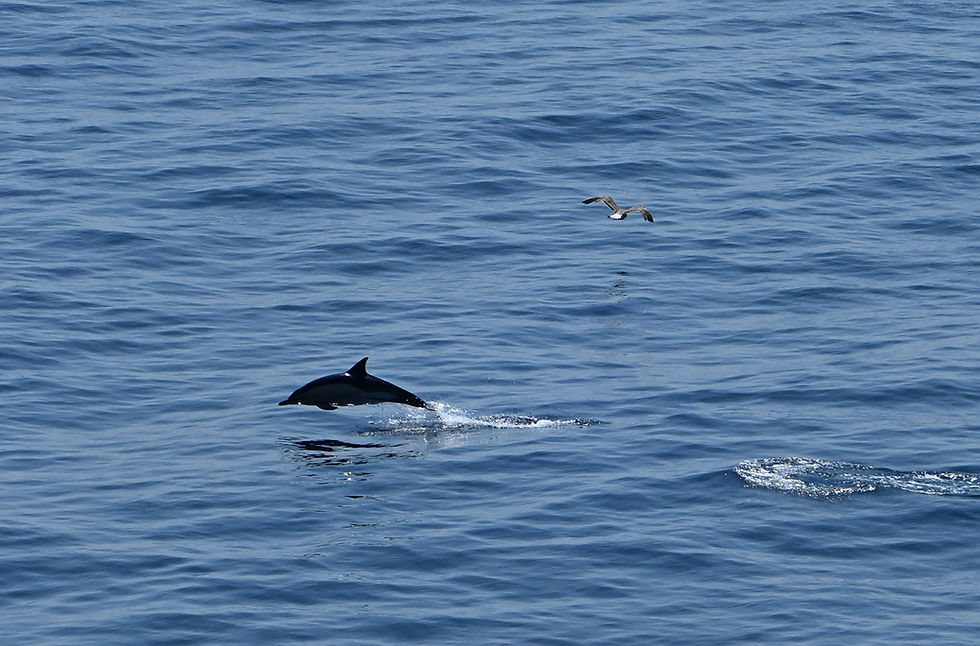
This summer I spent a couple of weeks in Spain, the journey was by sea on the Brittany Ferries route Portsmouth to Santander. I spent quite a lot of time looking for dolphins, Nikon Z8, 70-200 mm lens with a 2x teleconverter.
There is an enormous amount of sea out there, and a dolphin is not awfully large, and leaps quite quickly.
My temptation was to scan constantly in the hope of seeing one, but it's quite tiring, and there is a rather wonderful scientific problem with that idea.
As Rudyard Kipling would have said in the Just So Stories, "let me explain oh best beloved"
By trying too hard not to miss something, you can actually make it easier to miss.
Our eyes can't take in the world like a video camera, the brain would just see a blur.; if we scan rapidly from one point to another our eyes make movements called saccades, our eyes effectively jump in leaps across the scene taking snapshots, and the brain fills in the rest, but not always very well.
This is called saccadic suppression.
Normally we don't notice any gap at all. The brain gives us the impression of a continuous visual world.
But imagine what happens when the thing you are looking for only appears for a second or two.
A dolphin breaks the surface at anything up to 27km/hr.
You happen to be moving your eyes across another part of the sea at precisely that moment.
And it is gone.
So I stopped searching quite so hard. I was blessed by the first couple of leaps that give me direction, and there is my picture.
Rather than continually sweeping my eyes across the water, I began to look at one place and wait.
I wasn't staring at one tiny point. I was simply allowing my eyes to settle, .
and intentionally let my peripheral vision do some of the work.
Peripheral vision isn't particularly good at seeing fine detail, but it is very useful at noticing movement and change:
A disturbance in the water.
A flash.
A dark shape.
If something happened towards the edge of where I was staring, i was more likely to see it and then move my eyes towards it.
It is not a case of never scanning, but of slowing down so that you use your eyes to hunt with greater efficiency. The useful distinction is perhaps:
look, pause, notice, move; rather than endlessly trying to sweep everything into view.
Basically looking isn't necessarily seeing
And there is a wider lesson here, beyond photography to road safety
We tend to assume that because our eyes have passed over a scene, we have seen it.
That isn't necessarily true.
There is even a serious parallel in driving. Cyclists and motorcyclists can sometimes be physically within a driver's field of view without being properly registered.
There are several reasons for that, including attention, expectation and the way our eyes move, so it would be far too simplistic to blame saccadic suppression alone.
But it is another reminder that looking in the right direction is not quite the same thing as seeing.
And photography is full of the same phenomenon.
We scan a landscape looking for a photograph.
We look at the same scene several times and then, suddenly, something that was there all along becomes visible.
Perhaps sometimes the answer isn't to look harder. Perhaps it is to give our eyes, and our brain, enough time to notice.
Or as in the latin phrase translated; that you may look until you see.



Comments