Photographing Buildings at Dusk: When Artificial Light Brings Architecture to Life - Simple Photography Tips by Michael Blyth

Five Simple Tips for Photographing Buildings at Dusk
Arrive earlier than you think you need to. The most interesting light often appears during the minutes between daylight and darkness. If you arrive too late the sky will be black and the atmosphere lost.
Look for the balance between sky and building lights. The best moment comes when the sky still holds colour while the building lights have begun to glow. This warm and cool contrast gives depth and character to the photograph.
Be careful how you set the exposure. On a phone camera, tap somewhere on that is neither the brightest nor the darkest . This usually keeps the glow of the lighting while preserving detail in the architecture.
Grey days can often make the lights show better on the building.
Wait and watch the light changeDusk evolves minute by minute. The sky deepens in colour and artificial lighting grows stronger. Often the best photograph appears quietly a few minutes after you first think the moment has passed.
Last week I travelled to London to meet my eldest daughter for a birthday lunch.
Afterwards we visited the Wildlife Photographer of the Year exhibition, which is always inspiring.
One of last year’s winners, a chap by the name of Will Fortescue https://www.williamfortescue.com/ had attended a photography course for teenagers that I ran some years ago, so I was particularly sorry to have missed the exhibition then. Check him out - he's quite a photographer!
Later in the evening I attended a small gathering in the House of Commons celebrating twenty five years of the charity Kids for Kids, which supports vulnerable children and families in Darfur. https://kidsforkids.org.uk, and for whom I donate some of my 'giving' photography time.
On the way across Westminster I noticed something that people often overlook when photographing buildings at dusk
The building lights were beginning to glow, yet the sky still held colour. Because I was on a time-limit for entry to the Palace I was unable to capture the best moment by way of illustration, but the one i include shows how the effect is starting.
It is a short moment in the day, but one that can transform photographs of architecture
I've put a number of images to help you see what I mean.

Intentionally photographing buidlings at dusk is one of those things that needs to be more specific than a casual. As you will see from Image One, the lights that provide night-time illumination to the tower and clock-face are lit, but the daylight is not yet over.
Being early avoids missing the perfect moment and finding a black sky.
Had I the time, I would have waited for the sky to darken further, which would have heightened the illustration of that short period when natural light and artificial light balance.
The result is often stunning, and if you search the web you will find some amazing examples.

Image Two, taken a couple of hours later - it was a good party - shows the full effect of the articicial lighting - typically from below pointing upwards.
As an aside, it's quite intrusive to my mind that the roof of the tower has virtually disappeared into the night. It has no dedicated lighting so the illumination is truncated.

We now come to three images designed to help you use your phobe more effectively - or the metering system on a camera.
As you can see from the screenshot Image Three, the phone has selected the brightest point as the point of exposure, but that has left the rest of the image intolerably dark.

With Image Four I've tapped on the screen to expose on one of the gate posts. A big improvement, but too tight on framing the picture, with the result that the gates drag your eye down and out of the picture.

Image Five, where I've tapped on the gates has worked better than I expected - I'd expected it to change the surroundings too much, but it's worked well.
The inclusion of some pavement has brought much better balance and Big Ben sits almost centrally.

Moving on to images Six and Seven, this is almost right in terms of the lighting - taken from beside the Utrecht Canal.
Image Six - is one of those days when. you're travelling and the day is just grey - nothing like the travel brochures - you're left with making the best of it. You've found some reflections, autumn colour just starting, the famous tower on a vertical third with it's reflection in the canal.
But it's sort of missing something.

Image Seven, disappear into a tailors shop for an hour or so and by the time you come out, all is changing. The shops and understory have lit, as have the light on the tower. Again, not perfect, but I'm trying to help you do better rather than exquisite - that comes with time and seeing.

Images Eight and Nine, taken at the Hague on another trip to the Netherlands give a further illustration of the process.
Image Eight is taken from a less 'into the light' perspective, about five minutes before the latter. There is so much more light and less contrast. The Governemt buildings are gently lit as the light fades, but there is a lovely amount of foreground light to balance the image.
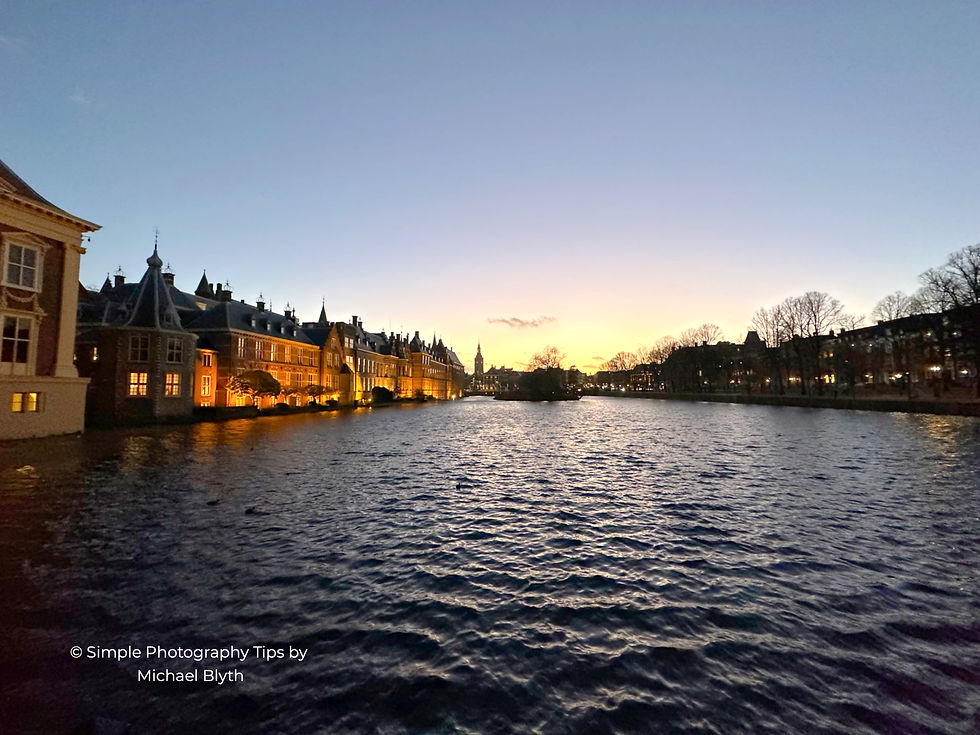
Image Nine - taken a few metres to the left of the other, the light has faded in those few minutes, the scene has turned cold and there is much more contrast.
The lights on the buildings have become much more dominant.

Image Ten, is the same image.
For those of you who have followed my blog for the whole journey so far, a year last week, know that I dis-encourage post adjustment, framing and cropping, but sometimes it just works, especially as this wide format sits more comfortably with your eyes and what gets seen.
Cropping out the lower part of the image takes the image to a different point visually - I've not changed the settings, but because the dark is gone, the contrast is less obvious and the image appear lighter.
Many people rush past famous buildings and take a photograph immediately.
It is worth waiting.
The light changes minute by minute during dusk. A sky that feels dull can become rich blue ten minutes later. Artificial lighting strengthens as the winter evening progresses.
Stand still, watch the light change, and let the scene reveal itself before taking the photograph.
Hope that helps.
If you want to keep the momentum, subscribe to Simple Photography Tips by Michael Blyth and I’ll send you the Wednesday posts and Friday thoughts as they go live.
If you’re already subscribed, you might have missed my recent email about a new level of involvement with Simple Photography Tips by Michael Blyth, a small, more active space where you’ll get weekly suggestions to help you move forward; get out, notice more, learn to see, and share what you’re making with a handful of like minded others.


Comments