Simple Photography Tips by Michael Blyth: Indoor Photography and Field of View

Three Simple Photography Tips If You've a pile of Food in Front of You
Your chosen Field of View controls what the photograph is about.
Most of the time rocking your body, and thus the camera forwards or backwards has more impact than changing focal length.
Ask yourself What do I want the viewer to notice first?” Then adjust your field of view until the answer feels obvious.
These indoor photography tips came not from a studio setup, but from a simple plate of moules — mussels — on the table in front of me, we were up on the Suffolk coast doing a Family Portrait session with a lovely family from York.
They'd pointed out, correctly, that it was the same distance for me to go to the area of the husbands childhood, as it was to York! Great photoshoot on the beach on a cold December day, proving that time of year doesn't matter with natural portraits, or photography as a whole - as long as you have the right attitude.
I digress! We'd bought these mussels from a local boat, sourced some wine, shallots and parsley, and cooked supper.
I'm going to use them as an example of choosing your field of view. There'll be other blogs on the same theme, but different image subjects.
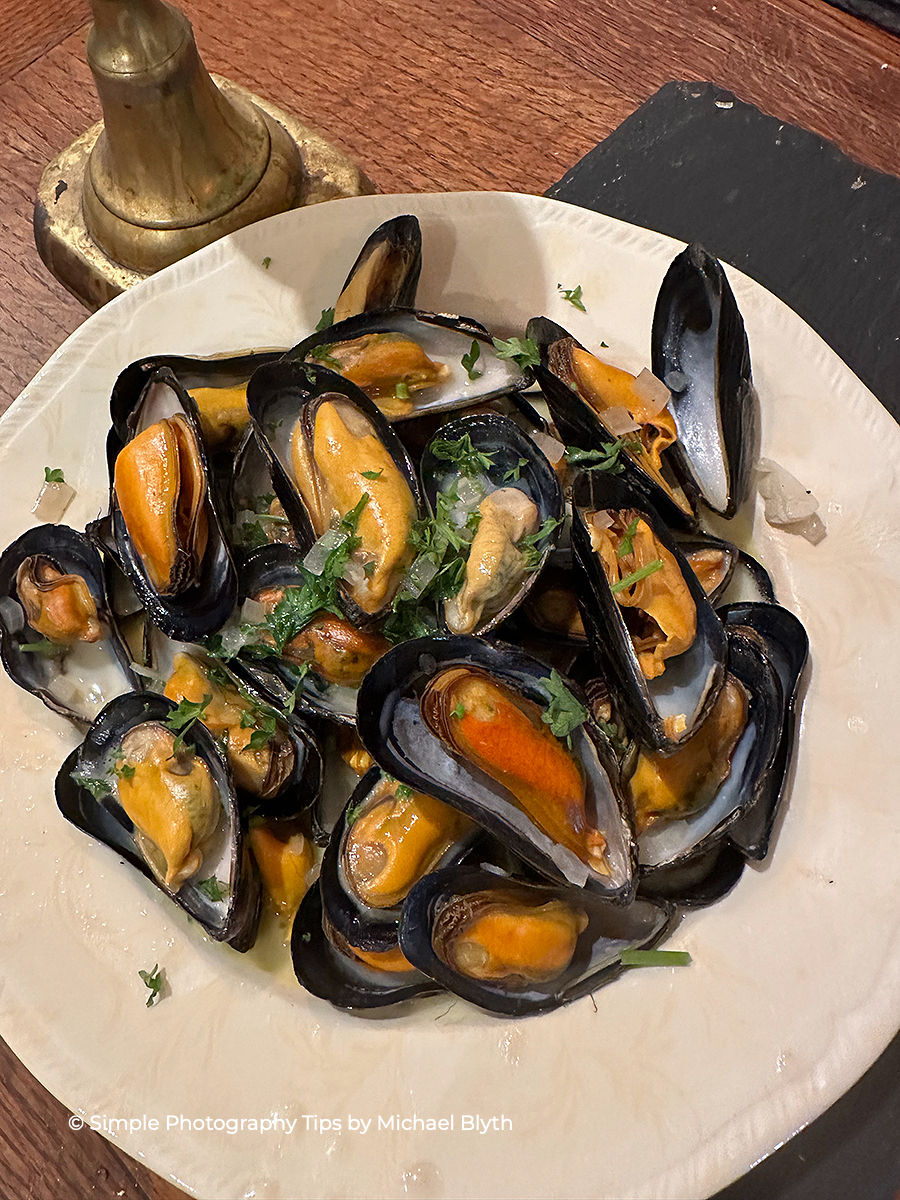
With Image One, I could have backed away further, used a wider angle lens and show the whole candle stick etc. but actually we were in quite a small AirBnb, and the backcloth would not have added to the picture in any way.

With Image Two, I've changed the angle slightly, and cropped in enough to exclude the candlestick. The brain is now much more focused than previously, when it may have been rather distracted.
Because of the background I didn't lower the camera angle, or there would have been too much extraneous junk in the background, and the artificial light, in the form of a spotlight, would have caught the surface of the lens and caused undesirable internal reflections leading to flare.

Image Three, to my mind the one that portrays the change from 'viewing my food to getting stuck-in'. There is sufficient in the image to be really focused on the textures, colours and to start the brain - food process.
I don't know about you, but when I look at an image I tend to automatically imagine it as a large image on display, and judge it's suitability on that basis.
I'd be happy with this on my kitchen wall.

Image Four, is actually a reject.
I've put it in to demonstrate a case of "nearly, but not quite".
it's just a little out of focus., definitely the part of the image in the lower left that really draws the eye. The colours are great , but the parsley just isn't on point.
If you want to keep the momentum, subscribe to Simple Photography Tips by Michael Blyth and I’ll send you the Wednesday posts and Friday thoughts as they go live.
If you’re already subscribed, you might have missed my recent email about a new level of involvement with Simple Photography Tips by Michael Blyth, a small, more active space where you’ll get weekly suggestions to help you move forward; get out, notice more, learn to see, and share what you’re making with a handful of like minded others.


Comments