The Effect of Frost On Wood – Simple Photography Tips by Michael Blyth

A winter frost turned the weathered surface of a teak table into a study of light, texture and pattern.
Five Simple Photography Tips for Photographing Frost on Wood
1. Look for transformation, not just subject
A garden table is just a garden table until frost changes it. What makes the picture worth taking is not the object itself, but what light and weather have done to it. Before lifting your camera, realise what has changed.
2. Move your viewpoint until the pattern begins to show
With subjects like this, a small shift in angle makes a surprising difference. Move left, right, higher or lower and watch how the grain, sparkle and lines either flatten out or suddenly come alive. These pictures work because the angle allows the frost to reveal the shape in the wood.
3. Use light that skims across the surface
Low winter light is wonderfully helpful with texture. When the light comes in from the side rather than straight on, it catches the frost and gives the surface dimension. Side light is often the difference between a record shot and a photograph with presence.
4. Get closer, then simplify
Close-up work asks for discipline. Remove anything that does not help. Let the pattern, texture and tone do the work. Frost lends itself beautifully to this because it turns ordinary surfaces into something almost abstract.
5. Stay with it long enough to see more
The first picture is not always the best one. The longer you look, the more possibilities appear. A wider view may explain the subject, while a tighter detail may become the stronger image. Frost is fleeting, which is all the more reason to slow down and let it reveal itself before it disappears.
We can still in most parts of the UK expect some more frosts, and it can be a time of real beauty, and an opportunity for some amazing experiments with light and angles and the way the aforementioned light shines through ice.
But there's also a quite particular aspect which can produce some quirky artwork for those walls of yours that are already heavily endowed with other artwork inspired by different blogs?
A couple of weeks ago i was outside with my new puppy doing the sort of things puppy's do to profusion in the early morning. The outside table had been gently painted with a fine layer of frost, and had picked out the features of the grain to a qute remarkable degree, highlighted by the low angle of the sunshine..
As I spent some time looking at the ways the light changed the effect of frost on wood, I started to notice more and more about the interractionbetween them, and spent time playing around with angles, which allowed variation of texture.
Let's go through a few and see what we can learn together - these blogs can be just as much journeys of learning for me, as I hope they our journeys of inspiration for you..

I took Image One to demonstrate the fact that this table was just sitting in the garden, with lazybones here having failed to put the chairs tidily.
Whilst not as abstract as a result of having chairs as an 'identifier' it does give a sense of place, and allowed me to angle the phone camera to let the sunlight to light the far end of the table.

The second Image is notable for the 'weighting' caused by the heavier grain in the bottom right of the image. Interestingly the diagonal line between the planks, which otherwise would drag the eye up to the top left actually just helps balance the picture - at least to my mind.
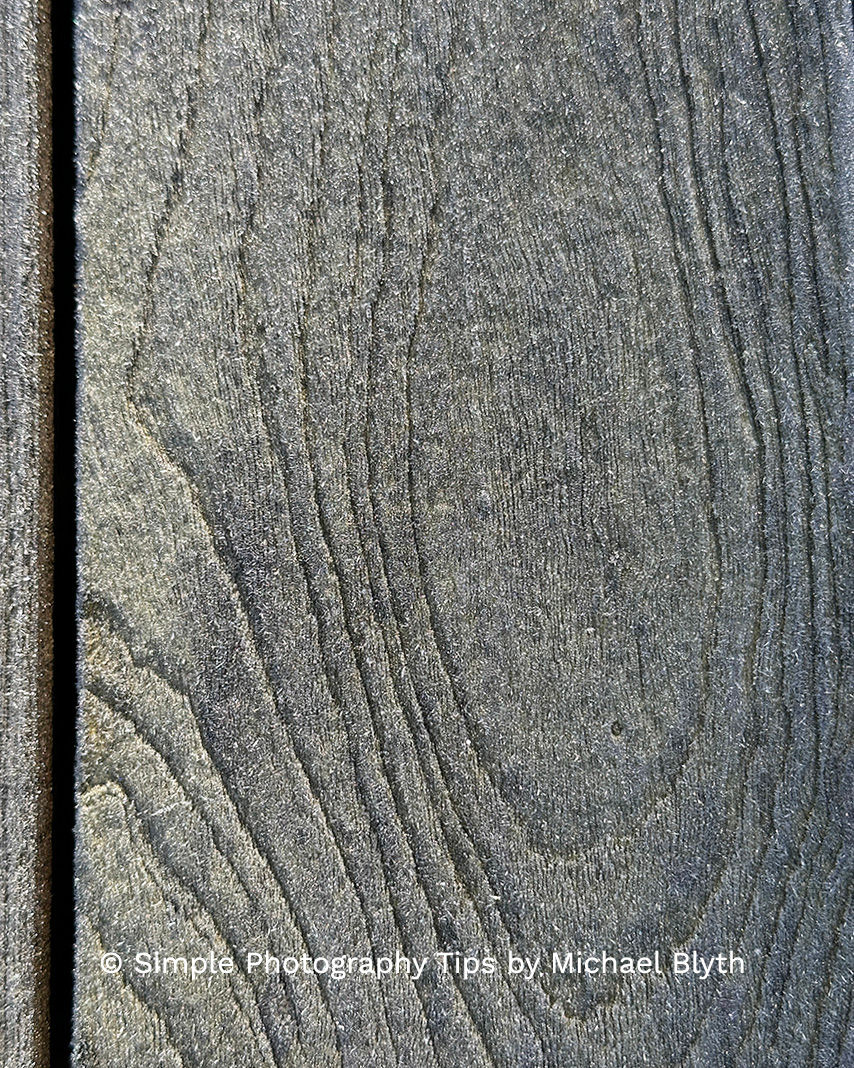
Image Three has been yet another lesson for me as I would normally make sure to not include the black line of the gap between the planks, but I find it quite gripping visually.
The frost is sucha fine layer that it could almost be absent, except for the way the light plays through the crystals and highlights the grain of the timber.

With Image Four the way the saw has sliced through the tree rings shows more evenly than in the earlier images because the light is more even.
Each image has little differences that gently demonstrate how light, grain and pattern are a source of fascinating imagery - and the longer you look at these, the more you will notice.
It's a reminder that photographs can be found in very ordinary places, given the circumstances and the practise of noticing.
Nice table, but I've never been tempted to photograph it before, thank you frost and sunshine.
If you want to keep the momentum, subscribe to Simple Photography Tips by Michael Blyth and I’ll send you the Wednesday posts and Friday thoughts as they go live.
If you’re already subscribed, you might have missed my recent email about a new level of involvement with Simple Photography Tips by Michael Blyth, a small, more active space where you’ll get weekly suggestions to help you move forward; get out, notice more, learn to see, and share what you’re making with a handful of like minded others.


Comments